
Payroll teams are under pressure to process increasing volumes quickly, accurately and compliantly. Workflow automation can reduce repetitive administration, create more consistent processes and allow experienced payroll professionals to concentrate on exceptions, client service and the decisions that still require human judgement.
Payroll is one of the most important functions within any organisation. Employees expect to be paid correctly and on time, while businesses must meet strict reporting, tax, pension and compliance obligations.
Despite this, many payroll processes still depend on a sequence of manual tasks.
Moving towards workflow-led payroll
Workflow automation connects the individual stages of payroll into one structured process.
Instead of treating calculations, HMRC reporting, payment preparation and payslip distribution as separate activities, an automated workflow allows each stage to follow the previous one.
For example, an approved spreadsheet import could initiate the payroll process. The system could then calculate PAYE, National Insurance, pensions and statutory payments, prepare the RTI submission, generate the appropriate payment file and distribute payslips through the agreed channels.
The objective is not simply to make payroll faster. A well-designed workflow should also make the process more consistent and easier to manage.
Automation does not remove oversight
Payroll automation should not mean removing people from the process entirely.
Experienced payroll professionals remain essential for checking source information, dealing with exceptions, answering employee questions and identifying unusual circumstances. They also provide the judgement needed when legislation, client requirements or worker arrangements create additional complexity.
The most effective automation removes predictable and repetitive administration. This allows payroll professionals to spend more time reviewing exceptions rather than manually completing every standard step.
Automation should also be supported by appropriate permissions, audit trails and approval controls. Businesses must remain confident that the right information is being processed and that sensitive payroll data is only accessible to authorised users.
Supporting growth without increasing administration
Payroll volumes can increase rapidly, particularly within recruitment, umbrella and outsourced payroll businesses.
Traditionally, increased volume has often meant increasing the size of the payroll team. However, before recruiting additional administrators, organisations should examine whether their existing processes are creating unnecessary work.
A fragmented process may require several manual actions for every payroll run. As volumes rise, these actions are repeated hundreds or thousands of times.
Workflow automation can help businesses process higher volumes without administration increasing at exactly the same rate. This does not mean that growing organisations will never need additional employees. It means their existing teams can use their time more effectively and concentrate on providing a reliable service.
Introducing Octopaye’s FLOW
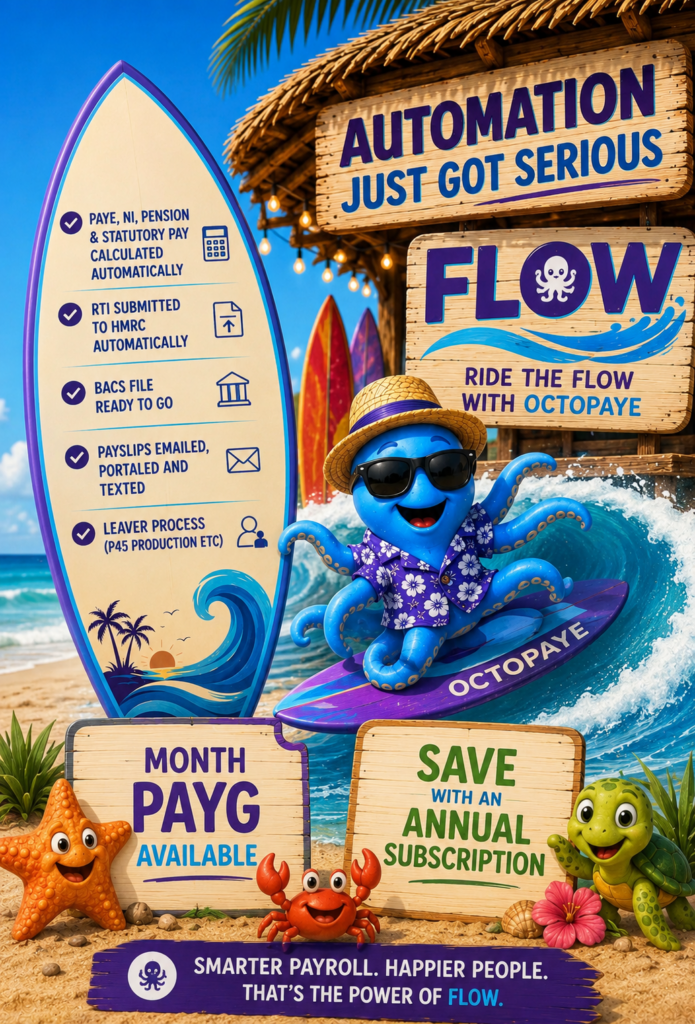
Octopaye has developed FLOW, its Payroll Workflow Module, to connect the payroll journey from timesheet import through to employee payment.
Following a single spreadsheet import, FLOW can calculate PAYE, National Insurance, pension contributions and statutory payments, submit RTI information to HMRC, prepare the BACS file and distribute payslips by email, employee portal and text message.
FLOW is designed to help payroll teams reduce repetitive administration, create a more consistent process and handle increasing volumes without unnecessary manual intervention.
Further information about Octopaye and FLOW is available at www.Octopaye.com.