
By Deb Murphy, Head of Operations, FCSA
Britain’s employment tribunal system was already creaking before a single clause of the Employment Rights Act 2025 took effect. Now, with the Act rolling out in phases through 2027 and a fresh consultation on zero-hours contracts threatening to channel yet more disputes into the same overstretched courts, the question facing recruiters, employers and contractors alike is no longer whether the tribunal system can cope – it’s how much worse this is going to get before anyone fixes it.
Should an employee have to wait years to have their problem heard?
Should the employer have to bear the cost of this, as those who are involved may have left and memories fade?
A backlog that keeps breaking its own records
The numbers, drawn from the Ministry of Justice’s own quarterly statistics, tell a story of a system in freefall. At the end of Q4 2025/26, there were 531,000 open tribunal claims. This figure has been climbing steadily, quarter after quarter, for several years. So even when they are closing 11,000 a quarter (in Q4) and the judges are working flat out, the open cases will continue to rise.
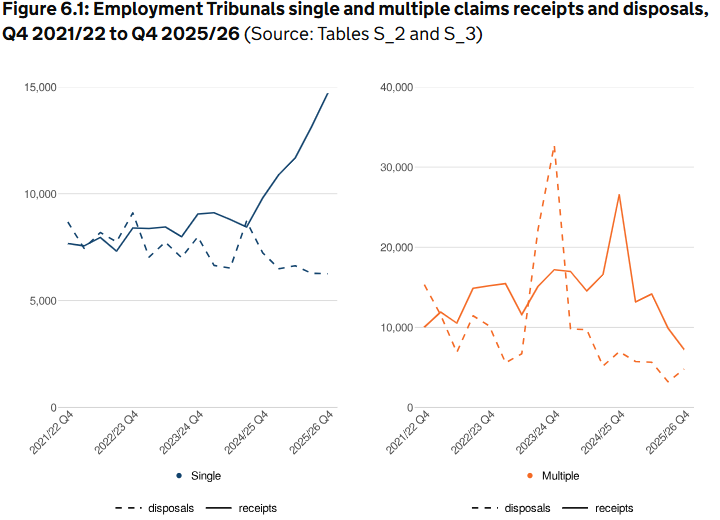
Source: Tribunal Statistics Quarterly: January to March 2026 – GOV.UK
That imbalance is structural, not seasonal. In the previous quarter, tribunals had a clearance rate of under 44%. The Law Society’s analysis of the same data shows single-claim cases open at the end of March 2026 had reached 64,000, up 42% on the year before; multiple claims (the larger, often higher-profile group cases) stood at 467,000 open cases.
The human cost of those figures is measured in time. Single day hearings are often over twelve months ahead, with five-day hearings in South London being listed into 2029, and investigative reporting has uncovered tribunal dates being set as far out as 2030. The Law Society commented that ‘swift justice is a vital public service, not a luxury’.
Why London is the epicentre
The pressure is not evenly spread. London and the South East between them absorb around half of all tribunal claims filed in Great Britain, and it is there that capacity has fallen furthest behind demand. A recruitment drive aimed at filling 36 full-time-equivalent salaried judge posts is expected to deliver only around 25, with the entire shortfall concentrated in London. Since 2022, the total number of employment judges in England and Wales has fallen by close to a fifth. Meanwhile, sitting days have actually been cut this year by around 1,000 compared with two years ago, a reduction only partly offset by last-minute funding from the Department for Business and Trade.
Acas, whose early conciliation service is the mandatory first stop before any claim reaches a tribunal, is itself registering record demand: more than 135,000 notifications between April 2025 and February 2026, on course for roughly 150,000 across the full year, the highest level it has ever recorded. They state that 66-68% of early conciliation cases do not progress to an employment tribunal, but that means 32-34% do, and when we are in tens of thousands of notifications, the tribunals will be hearing around a third of these.
The Employment Rights Act: more rights, more routes to a claim
Is it going to get worse? None of this backlog factors in what is coming. The Employment Rights Act 2025 is the most significant rewrite of UK employment law in a generation, and almost every one of its headline reforms creates a new or easier route into the tribunal system.
From October 2026, the time limit for bringing most tribunal claims will double from three months to six. From a date expected in 2027, unfair dismissal becomes a “day one” right rather than something requiring two years’ service, with the government’s own estimate putting the resulting extra caseload at around 6,900 additional claims a year, on top of tens of thousands already filed annually. Add in new restrictions on fire-and-rehire, enhanced protection against dismissal during and after family leave, and a more demanding bar for what counts as a fair process, and it is little wonder that employment lawyers are warning, in increasingly blunt language, that the tribunal system is approaching the verge of collapse.
Zero hours reform: a brand-new tribunal pipeline
If the Act’s broader provisions widen existing routes into the tribunal system, its zero-hours reforms build an entirely new one, and this is where recruiters and contractor-facing businesses should be paying closest attention.
On 2 June 2026, the government opened a consultation, Make Work Pay: ending one-sided flexibility, setting out how it intends to implement the Act’s zero- and low-hours provisions. Three new statutory rights sit at the centre of the proposals: a right for qualifying workers to be offered a contract reflecting the hours they actually work over a reference period; a right to reasonable notice of shifts; and a right to compensation when shifts are cancelled, moved or cut short at short notice.
Each of those rights is designed, by statute, to be enforced in the employment tribunal. Workers denied reasonable notice will be able to bring a claim. Workers who don’t get paid the compensation for unreasonable notice will be able to bring a claim. Workers who don’t receive a guaranteed-hours offer they’re entitled to will be able to bring a claim. Dismissing or penalising a worker for accepting, rejecting, or relying on any of these new rights will be automatically unfair, potentially opening a further line of unfair dismissal litigation. And because the consultation proposes that “short notice” be defined as anywhere between one and seven days (it hasn’t yet been decided), with a possible higher-paying “very short notice” tier on top, disputes about which category a cancelled shift falls into, and how much compensation is owed, are squarely the kind of fact-sensitive disagreement that ends up in front of a judge.
The complexity multiplies in the recruitment and contractor space specifically. Agency workers are explicitly brought into scope, but through multiway relationships between worker, agency, umbrella (if applicable), and the end-client. The consultation proposes that hirers will usually be responsible for guaranteed-hours offers, while agencies handle short-notice compensation. But where a hirer is at fault, that liability is expected to be passed back to them contractually rather than resolved by the regulations themselves. Where notice obligations aren’t met, tribunals will have to apportion liability between two or more respondents, a more complex and slower exercise than a typical single-employer claim. Industry voices in the recruitment sector have already flagged that applying one uniform framework across temporary and freelance engagements is, in practice, far from straightforward.
The consultation closes on 25 August 2026, with implementing regulations and a firmer commencement date still to follow; current expectations point to 2027. But the direction is clear: a tribunal system already buckling under 531,000 open claims is about to be handed an entirely new category of dispute, generated by a low-paid, high-turnover segment of the workforce that is disproportionately likely to need to enforce its rights through formal channels rather than negotiate informally with an employer.
And let’s not bring AI into this, as some ‘online lawyers’ are making it a whole lot tougher. They are swamping the employers’ legal teams with pages and pages of information, which is sometimes just made up. It’s costly for employers, it’s time consuming, and it doesn’t bring the right outcome for the worker.
What this means in practice
For employers, the message from practitioners is consistent: the cost of getting workforce decisions wrong is rising even as the wait to find out whether you got them wrong stretches into years. Witnesses move on, memories fade and documents go missing long before a hearing date arrives, weakening employers’ ability to defend claims credibly. Tribunals have also tended to be generous in their assumptions about how long a dismissed worker might take to find comparable work, assumptions that compound when claimants are left waiting 18 months to two years for any resolution at all.
For recruiters and those operating in the contractor and umbrella market, the zero-hours consultation is a live opportunity, not just a future compliance headache. With the framework for “reasonable notice,” short-notice payment bands and agency liability all still open for consultation until August, there is a genuine window to shape rules that will otherwise be drafted around standard employment relationships and then awkwardly retrofitted onto temporary and freelance engagements.
For claimants, the picture is starker. Charities working with low-paid and vulnerable workers report that the psychological and financial toll of multi-year waits is already pushing people to withdraw claims or settle for far less than they are owed, simply because they cannot sustain the uncertainty. A tribunal system intended to be a swift, accessible alternative to the civil courts is, by its own regulator’s data, now taking the better part of two years to resolve some of the disputes most likely to affect people with the least capacity to absorb the wait.
The bottom line
The government has acknowledged the strain and pointed to extra sitting days, a new tribunal hearing centre in London and more judicial recruitment as evidence of action. But each of those measures is incremental against a backlog growing each quarter, a clearance rate stuck below 50%, and a reform agenda – the Employment Rights Act first, the zero-hours regulations to follow – both explicitly designed to expand who can bring a claim and on what grounds. Unless capacity is increased well ahead of those changes taking effect, rather than in response to them, the tribunal system risks becoming the genuine bottleneck in UK employment law: not whether a worker has a right, but whether there is anyone available to hear them assert it.